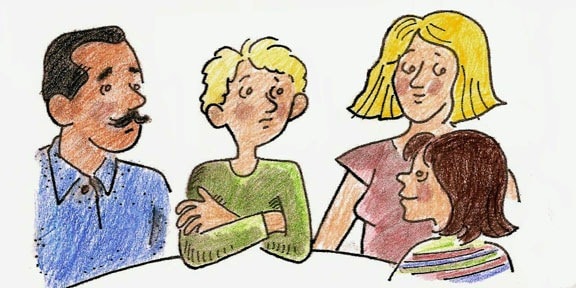
The teen years can be a particularly hard time for children to experience the divorce of their parents. This article from Risa Garcon explains why and offers some practical advice to both parents and teens.
STOP! If you are considering a divorce, do everything within your power to find another way. Divorce hurts. It will hurt your children whether or not they are willing to tell you. Divorce fundamentally changes the world they have come to know.
That said, we recognize that some people will still elect to get a divorce, or may find themselves in a position where they have no choice. In those situations, we hope that you will make every effort to lessen the impact divorce will have on your kids. Those efforts should start from the very beginning, and in this case the beginning is when you choose to tell your kids about the divorce.
The following lists provide guidance on the steps you can take to tell your children about your divorce in the best possible way. Though these steps will not eliminate all pain and hurt your children might feel, we hope that they will help to mitigate the impacts of divorce. Not all of these steps will be easy for you, but we encourage you to make every effort to take as many of these steps as you possible can. Whatever you do, be honest with your kids, do not tell your children the things listed below if you do not actually intend to do it.
Planning Ahead
Don’t tell your children until you are absolutely sure you are getting a divorce.
Tell the kids together with your spouse.
Determine with your spouse ahead of time what you will say to your children and who will say it.
Tell all of your children together at the same time.
Pick an appropriate time for the conversation. Do not pick a time where someone need to head off to a soccer game or business meeting.
Leave plenty of time for the conversation. Allotting an entire day and evening for this conversation would be best.
Pick a private place to tell your children the news. Do not have the conversation with family friends or relatives present.
Pick a place that is familiar and comfortable for your children. Do not have the conversation in a public place.
Anticipate questions your children might ask ahead of time and be prepared to answer them.
This website is the homepage of Christina McGhee. Christina is a divorce coach and parent educator. The focus of her work is on “helping children and families successfully manage the challenges of divorce.” The focus of much of what Christina does is to help children and families to use the difficult events and circumstances they find themselves in as a result of divorce as a catalyst for positive change.
AVAILABLE RESOURCES
Divorce and Children is packed full of useful information for divorced and divorcing who desire to help their children adjust. One of the best features of this page is a collection of resources for parents. These articles are packed full of great information for parents and cover topics like:
This article is a little bit on the simplistic side when it comes to advice about dating after a divorce, but if you are in that position it does offer some solid advice for how to make it easier on your kids.
Research shows that divorce impacts children well into their adult years. In fact Judith Wallerstein and her colleagues identified a “sleeper effect” where many children of divorce don’t even experience the full impact of the their parents’ divorce until years later as they become adults themselves. That said, there are very few resources available designed specifically for adult children of divorce. Chained No More is one of the very few resources written specifically to address the issues experienced by adult children of divorce.
After years of working with younger children of divorce and teen children of divorce, Robyn Besemann felt led to develop a program:
“…for the adult children of divorce to help them explore and address the issues connected with the divorce of their parents and other childhood brokenness.”
Divorce brings all kinds of changes into your life. Some changes are obvious. You no longer live in the same house with both your mom and your dad. Maybe you spend most of your time at one parents’ house and visit the other parents’ house every other weekend, or maybe you split your week between two houses. Sometimes one parent moves far away and most of your contact with them will be by phone or e-mail. In some cases, children of divorce don’t see one of their parents very often or at all. There are many other potential changes. You might have moved out of your house following the divorce and live in a brand new house or apartment. Maybe you go to a brand new school or you’re in a living in a new neighborhood or going to a new church.
Some changes in your life are not obvious. Other people probably don’t even notice these types of changes in your life at all, but you probably do. Maybe your family had a special Christmas tradition before the divorce that you no longer get to do. Perhaps you used to sit down every Saturday morning as a family for a pancake breakfast with dad that doesn’t happen anymore since the divorce. Maybe it’s as simple as missing how Dad used to stop by your bedroom door every night and tell you “Sweet Dreams” as you were drifting off to sleep. All of these little things may not seem important by themselves, but they form an important part of what we see as “normal.” We call these little things that you’ve gotten used to rituals and routines and they define what “normal” is to us.
One important things that you can do after a divorce to help things get back to “normal” is to come up with some new rituals and routines to engage in with your family. They may not be the same rituals and routines from before the divorce, but they can be just as fun and with time they will become just as important to you. You’ll need to come up with some rituals and routines that work for you and you family, but here are some suggestions:
If you live with your Mom, perhaps you and your Dad can exchange “good night” text messages every evening.
This article from the TeensHealth portion of KidHealth.org helps teens with various issues related to the divorce of parents. It is packed with useful tips and information for teens going through the divorce of their parents. It covers topics including:
Why are my parents divorcing?
Dealing with guilt and other emotions.
Life changes that come with divorce.
Ideas for making the divorce process easier.
Possible positive things that can come from divorce.
From kidshealth.org, this article is intended to help parents who are currently going through a divorce. The article starts with the following honest assessment:
What’s the best way to help your family get through a divorce? Every situation — and every family — is different. But some stress reducing guidelines might make the adjustment a bit easier.
These suggestions can make the process less painful for kids, teens, and families. Parents will need to interpret them in their own ways; honesty, sensitivity, self-control, and time itself will help the healing process. Be patient — not everyone’s timetable is the same.
This article includes helpful advice for parents on:
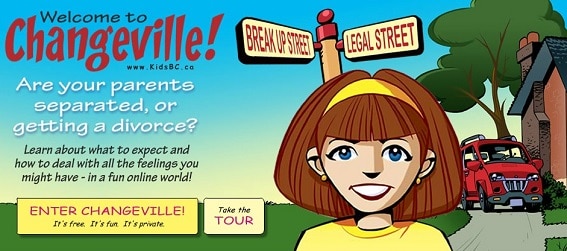
Changeville is an internet based game released in 2008 by the Justice Education Society of British Columbia, Canada. Changeville is an interactive, virtual world designed “to give children tools and information that will help diminish the fears and anxiety they may feel.” Some of the information contained within the game is targeted directly to residents of Canada (like contact information if kids need to talk to someone), but most of it applies to children from any country.
How it Works
We you enter the world of Changeville, you will be prompted to enter your name. You can also enter a password if you want to keep your information private. From there you customize your avatar (the character who represents you in the game) to look however you would like them to look. A map of Changeville appears, and you are prompted to pick an area of town. Your choices include:
Sometimes when parents talk to kids about things like divorce, they forget that you might not know what a divorce even is. Or, you might think you know what divorce is all about, but not really understand what it means when your parents get divorced. That’s ok, but it is helpful to know what a divorce really is when you hear the word used – especially if you are right in the middle of your parents’ divorce.
The word “divorce” is a legal term (something used by lawyers and judges) for when one or both people who are married choose to no longer be married to one another and end up no longer living together. They sign some legal papers that say that they are single again and free to marry someone else if they choose to do that. Although your day-to-day living arrangements might change, divorce does not in any way change either of your parents’ relationships with you. Even though your parents are no longer wife and husband, they are still your mom and dad.
Because divorce is a legal proceeding, the people involved (your mom and dad) usually have lawyers or attorneys to explain the laws to them and speak for them in court. If your parents are getting divorced, you may have to speak to the lawyer for one or both of your parents. In some cases (especially where parents are having a really hard time getting along), a special lawyer or person is appointed for the child to represent their interests during the divorce. This person is appointed by the court and are often called a Guardian Ad Litem. In some places, they are called Court Appointed Special Advocates.
The purpose of the divorce proceeding (including all the meetings and court appearances) is to determine how to split up the assets (all the stuff your parents own) and the custody of any children (how much time you will spend with each parent and when).
Some divorces end up in a court room before a judge who will make decisions about how your parents’ divorce will work including issues related to where you will stay. If your parents can work out the details of their separation together with their attorneys before going to court, that is called a settlement.



 The teen years can be a particularly hard time for children to experience the divorce of their parents. This article from Risa Garcon explains why and offers some practical advice to both parents and teens.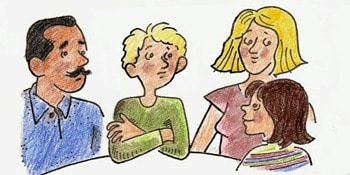

 This website is the homepage of Christina McGhee. Christina is a divorce coach and parent educator. The focus of her work is on “helping children and families successfully manage the challenges of divorce.” The focus of much of what Christina does is to help children and families to use the difficult events and circumstances they find themselves in as a result of divorce as a catalyst for positive change.
 This article is a little bit on the simplistic side when it comes to advice about dating after a divorce, but if you are in that position it does offer some solid advice for how to make it easier on your kids.